
Let’s look at a few things about tea..
Not the “Mountain” tea as we call it here in Greece but the tea which comes from China, India and generally from Asia.
The tea from Asia comes from a plant called Camellia Sinensis and the plant, which has many varieties, is cultivated in many different environments, with different soils, altitudes and climates etc.
We collect the leaves from this plant which, after many processes is put into boiling water and served as tea.
Whichever tea leaves are collected and the way we process them has a lot to do with distinguishing the different kinds of tea.
And there are 6 types. And I’m not talking about tastes, take note..I mean the age of the leaves, the selection and the finishing processes.
These different types of tea are the black, the green, the white, the yellow, the oolong and the dark tea (pu-erh).
But what processes are used to make the finished tea product?
After collection, the leaves are left to dry and oxidise for a long or short time and then they are warmed for a while too. They could turn them and cut them up too and do other processes.
So what is the point of all that and why should we be interested? Well the processes such as oxidization and all the others that occur are instrumental in the taste of the finished tea product.
What is oxidization? It is the process in which enzymes in the leaves react with the oxygen in the air creating this process.
To be clearer let’s take as an example the apple. If we cut it down and leave it for many days it will start to go brown- this is the process of oxidization happening. If we cut it open and leave it, after a few hours it starts to go brown this is the faster process of oxidization when the flesh inside is exposed to the oxygen in the air.
If we cut the apple into slices and fry them in a pan the oxidization stops and the slices do not change colour, the same thing happens with the tea leaves. If we cut them up and leave them out exposed to the air they darken in colour through oxidization, but if we bake them they do not change colour and the process of oxidization is halted.
We can see this most clearly in the difference between green and black tea for example. The black tea with it’s dark colour has been through a lot of oxidization. The green tea has been through almost none by being heated up to stop the oxidization process.. The White tea then, what is it? It is the product of very young leaves, the ones that have not rolled up on themselves yet and still have little white ‘hairs” on them to protect them. It is from these ‘Hairs” that the tea gets its name and not because it is particularly “white” in colour. It is a very light tea with a great taste and I like it a lot. It also has hardly any processes to achieve the finished product. They simply collect the leaves and leave them to dry for two days. In this time a little oxidization occurs so some leaves end up still green others brown and some darker.
For Green tea once the harvest has occurred, they leave the leaves to dry out and then they roll the leaves and either steam them or bake them to stop any further oxidization.
Oolong tea is somewhere between Green and Black tea and the oxidization is around 80%. The process to achieve this takes a long time and each producer has their own secret process to achieve this blend including differing levels of oxidization and baking etc.
Black tea (which the Chinese actually call red tea) is a tea with a long period of oxidization and it’s the tea with the strongest flavour and is the tea that the English drink with milk.
The Dark Tea or (pu-erh as it is called in Yunnan, China) is a specialist tea which undergoes many processes- after being rolled and dried it is taken through a process of microbial fermentation and oxidization to achieve the finished product. It’s price is determined by the length of the process it has undergone and it is a “live” tea like wine and is sold in a similar way to wine according to age and process.
Although the Pu-erh is my favourite tea which I drink as it comes, the white tea is something with which I “play” adding other herbs and plants to create my own blends. As with olives and olive oil some of these teas have high levels of polyphenols, antioxidants in other words, like catechins. They are perfect for protecting the heart, protecting us from cancer, high blood pressure and help with weight loss as is Green tea.
Also white tea is easy to prepare. Simply add hot but not boiling water (75-85C) in a teapot with the tea leaves, leave for between 4-8 mins and serve without sugar as it doesn’t need it..
For each cup if the leaves are big we put 1 table spoon and if the leaves are small I tea spoon.
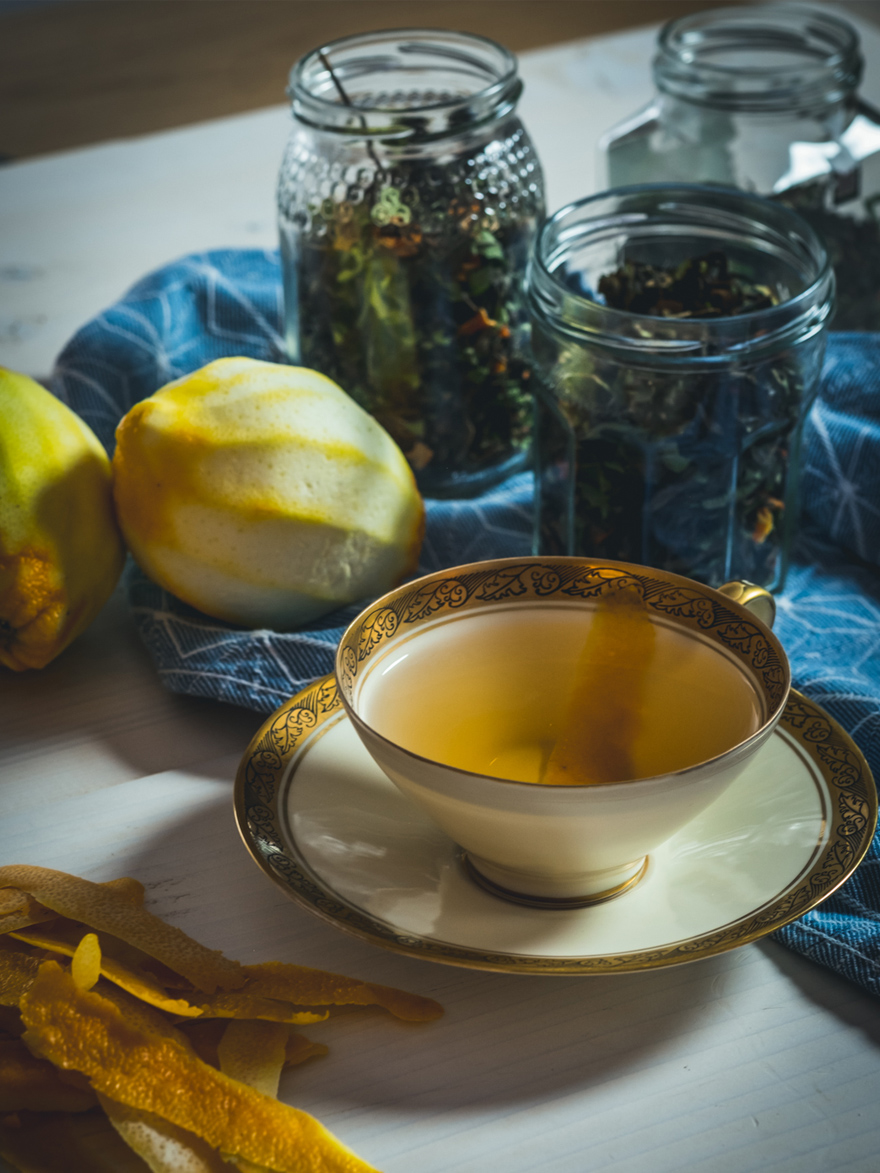
Let’s see how I made my own blend with Bergamot.